Water Extraction in Boston, MA
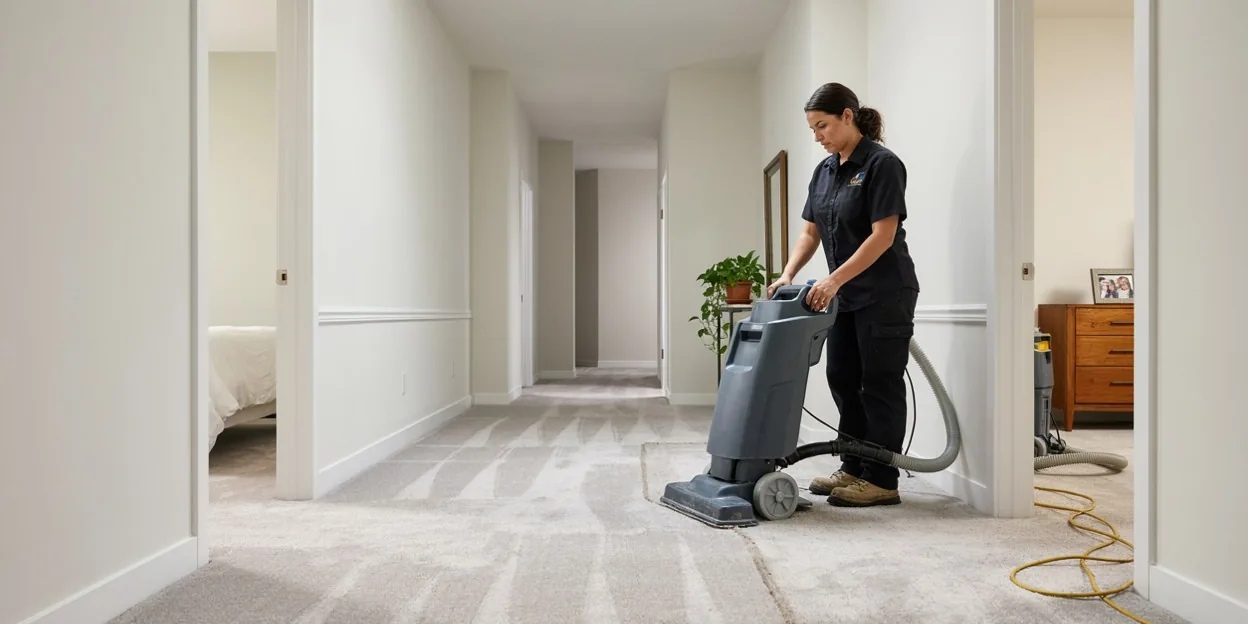
You came down the cellar stairs for the laundry and stopped on the third step. Two inches of water covers the slab, the bottom of every cardboard box has gone dark, and the furnace is standing in it. Call us now and tell us what you see. An independent local provider who does water extraction in Boston and the inner-ring cities takes it from there.
What the crew does first
The crew makes sure the water is off and the power to the wet area is safe, then gets the bulk water out. In a basement that means a submersible pump if the water is deep and truck-mounted or portable extractors once it is down to the slab. Upstairs it means weighted extraction on carpet and wet vacuums on hardwood and tile.
Then the metering starts. A Boston basement has water in places you cannot see: behind the paneling, under the sleepers beneath a finished floor, in the bottom plate of a partition wall. Upstairs, water that pooled on a kitchen floor is already in the toe kicks and down through the subfloor into the ceiling below. The crew maps all of it before deciding what stays and what opens.
What to do in the next hour
Shut the water off if the source is a pipe or an appliance and you can reach the valve safely. Do not step into standing water in a basement with the power on. If the panel is down there and the water is anywhere near it, leave it alone and say so when you call.
Move what you can carry off the wet floor. Get rugs up. Open the doors under the sink and the panel behind the tub. Take photos of every room from the doorway before anything is thrown out. Then call. Say whether the water is clean supply water, rain or street water, or from a drain, because that changes how the crew arrives.
What is usually saved and what is not
Hard floors, framing, and plaster that got wet for a day or less usually dry in place. Oak flooring that is caught early can often be dried with mats. Solid wood furniture that only got its feet wet can be cleaned and dried.
Carpet pad, particleboard cabinet bases, cardboard, and anything upholstered that sat in water usually go. Wet cellulose or fiberglass insulation in a basement wall almost always comes out, since it held the water against the framing. If the water came from a drain or the street, the list of what leaves gets longer. Ask the crew what is being removed and why before it goes to the curb, and photograph it first. Once the bulk water is gone, the rest of the job is structural drying.
Suffolk County notes: basements that were never meant to be dry
Nearly every house in Boston and the inner ring has a basement, and most were dug in the 1880s through the 1920s with fieldstone or brick walls and a slab poured later, if at all. Those walls pass groundwater at the joints. A finished basement in a Dorchester triple-decker or a Somerville two-family puts carpet, drywall, and a family room on top of that, and the extraction has to reach every layer.
The other Boston pattern is the stacked loss. A washer hose on the third floor of a triple-decker is a puddle upstairs, a ceiling stain in the middle unit, and a wet basement by morning. Say how many floors are involved when you call. When street water or a backed-up sewer is in the mix, the crew treats it as contaminated, and the job becomes basement flooding cleanup or sewage cleanup rather than a clean-water extraction.
Many policies cover a sudden loss such as a burst pipe or an appliance failure. Groundwater and sewer backup are often excluded without a rider. Ask the crew to photograph the water line and record the first readings so your adjuster has a starting point.
Calling about water extraction
Say where the water came from, how deep it is, and which floors it reached. Mention if the electrical panel or the furnace is standing in it, whether the water has been shut off, and whether other units in the building are involved. Call (857) 524-9927 now and tell us what you see.